
Committee Mission
The SAME Membership Committee develops and communicates to all Posts the strategies, best practices, and tools that are most effective for them to grow their membership, to foster greater member engagement and leadership, and to enhance their members’ experience with SAME, further enabling each Post to support the current Strategic Plan of the Society.
Join the SAME Engage Membership NetworkOverview
As one of the “operational” Communities of Interest (vs. “technical” COIs), the Membership Committee serves as an extension of the national office staff to assist all Post leaders, especially Posts’ Membership Chairs/POCs, with the tools, resources and connections necessary to help enhance their members’ society experience through their locally relevant Posts. Between our COI members and the post membership chairs/POCs, invited to our calls and sponsored webinars, we are over 140 people strong across SAME.
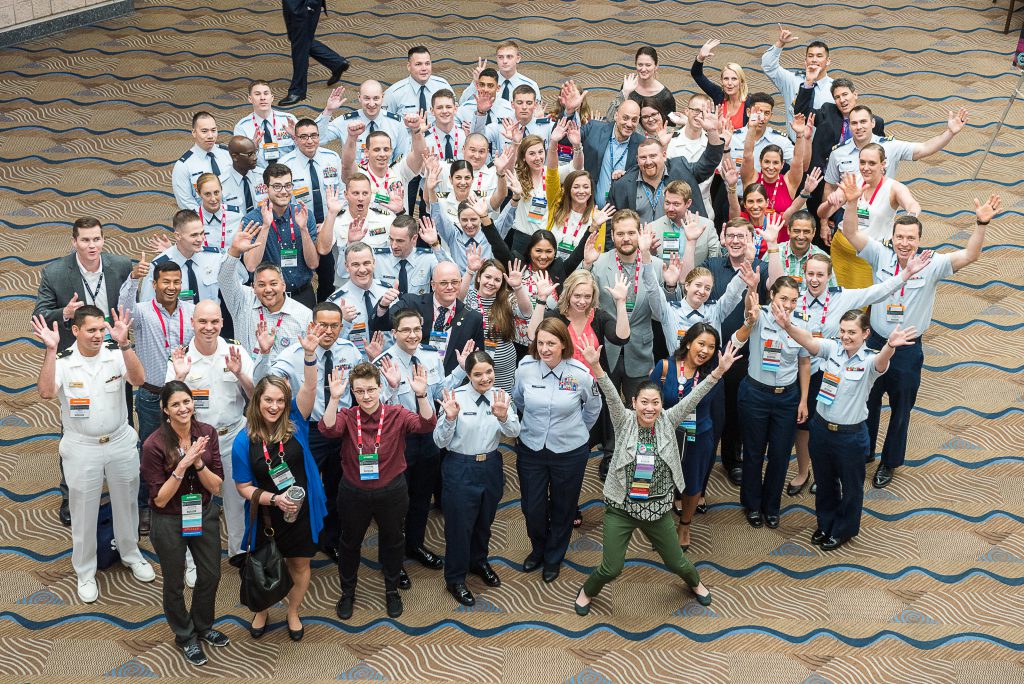
SAME’s Membership Committee is open to any SAME member to participate. Unlike many of our other COIs that focus in on special professional and technical interest areas important to SAME members, the Membership COI provides participants with a broad-ranging opportunity to become involved at the national level. Our forum has the potential to positively impact the experience of every current and future member of the society as it pursues its strategic goals.
COI Objectives
- Provide opportunities to foster connections with other Post leaders across all sizes and post geographies
- Engage with best practices employed at other Posts by their leaders and members
- Share creative tools and resources aimed at improving post level retention and recruitment successes
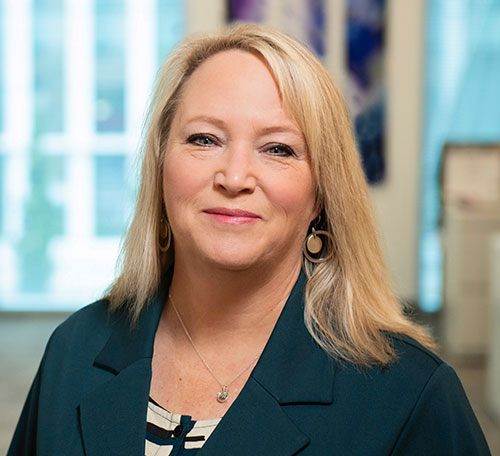
Committee Chair
Organization Structure
Vice Chair, Tools & Resources: Dick Kochanek
Chair-Elect, Strategic Direction: Lee Ann Zelesnikar
Diversity, Equity & Inclusion:
- Shante Fields – Mead &Hunt
- Lalitha Benjaram – Mead & Hunt
Staff Liaison: Jill Murphy
Webinar: Understanding the New Membership Structure
Military Membership – What’s in it for You?
Upcoming National Webinars
-

- Webinar
Solving Complex CVOC Problems with ISTR– Field Proven Approaches
This webinar will first discuss the unique aspects of performance-based designs when considering procurement of thermal remediation services. Next, we will discuss how to evaluate criteria when selecting performance objectives, i.e., “ how do you define success?” -

- Webinar
The National Spatial Reference System: Modernizing Our Geodetic Foundation for the Future
The National Geodetic Survey (NGS), within the National Oceanic and Atmospheric Administration (NOAA), is in the process of making the critical transition from the current National Spatial Reference System (NSRS) to the upcoming, modernized (2022) system. -

- Webinar
CMMC Level 2: What A/E Firms Must Know Before November
Starting November 10, 2026, the Department of Defense will require CMMC Level 2 certification for contractors handling Controlled Unclassified Information (CUI). Unlike prior self-attestation requirements, this mandate requires verification by an accredited third-party assessor before a firm can be awarded or retain applicable DoD contracts.

Related TME Articles – Membership
-

An Installation of the Future: Planning, Programming, and Funding the Tyndall Rebuild
In the wake of Hurricane Michael, Tyndall AFB embarked on a visionary journey to become the “Installation of the Future”—a multi-layered program driven by reimagined master planning, resilient design, and flexible funding. -
Crossing a Landslide in Alaska
By leveraging collaborative delivery and a commitment to close partnering, the construction of a 475-ft single-span steel truss bridge over an active landslide in Denali National Park and Preserve has been able to successfully overcome evolving site concerns and significant geology challenges. -
A Standardized Approach to Aircraft Fire Training Infrastructure
To support enterprise-wide airmen readiness, the U.S. Air Force is modernizing its standard design for aircraft fire training facilities—introducing digital controls, dual-fuel systems, and PFAS-conscious infrastructure. -
Delivering Energetic Materials Manufacturing Facilities
Designing and constructing facilities that manufacture, process, handle, or store explosives and energetic materials present some of the most challenging defense projects—requiring technical experience, strict safety protocols, and a comprehensive understanding of regulatory frameworks.


