
Community Mission
The mission of the Facilities Asset Management (FAM) Community of Interest is to enhance the efficient, effective, and sustainable stewardship of federal facilities. We achieve this by connecting Department of Defense and industry leaders with those seeking knowledge in asset management (AM), providing a collaborative platform for sharing resources, technologies, and strategies that support informed decision-making and risk management. Through research, advocacy, and professional development, we address current and future challenges in facility management to ensure long-term success.
Join the SAME Engage FAM NetworkCOI Objectives
- Foster Knowledge Sharing: Provide a platform for Department of Defense and industry leaders to exchange knowledge, resources, and best practices in asset management (AM).
- Promote Collaboration: Facilitate partnerships between industry, government agencies, and FAM thought leaders to address the challenges posed by constrained funding, hybrid workspaces, and extreme weather impacts.
- Expand Learning Opportunities: Offer a variety of forums, including webinars, the FAM Session Track, and the FAM Forum at JETC, for continuous learning and professional development.
- Leverage Cutting-Edge Technologies: Collaborate through the Geospatial Working Group on advanced technologies such as digital surveying, 3D modeling, and site picture generation.
- Support a National Asset Management Mission: Engage in the ongoing national effort to enhance asset management practices and drive innovation across industries.

Community Chair
Rigo Cisneros, Jacobs
Vice Chair: Vacant
Immediate Past Chair: Michael Zapata, AFCEC
Management and Strategy Chair: Jeff Freemyer, ManTech
Operations and Maintenance Chair: Rigo Cisneros, Jacobs
Programs and Education Chair: Matt Anderson, AtkinsRealis
Communications Chair: Carole Mahady, LMI
Vice Chair, Technology & Innovation: Jeff Freemyer, ManTech
Post Liaison: Vacant
Young Professionals Liaison: Tim Cunningham, Fisher Engineering
JETC FIAM Session Track Chair: Tim Cummingham, Fisher Engineering
SAME National Office POC: Ree Miskimon, FSMPS
FAM COI Working Groups
Chair, Doug Kaiser
Chair, Mike Grussing
Upcoming Events
Upcoming National Webinars
-

- Webinar
Solving Complex CVOC Problems with ISTR– Field Proven Approaches
This webinar will first discuss the unique aspects of performance-based designs when considering procurement of thermal remediation services. Next, we will discuss how to evaluate criteria when selecting performance objectives, i.e., “ how do you define success?” -

- Webinar
The National Spatial Reference System: Modernizing Our Geodetic Foundation for the Future
The National Geodetic Survey (NGS), within the National Oceanic and Atmospheric Administration (NOAA), is in the process of making the critical transition from the current National Spatial Reference System (NSRS) to the upcoming, modernized (2022) system. -

- Webinar
CMMC Level 2: What A/E Firms Must Know Before November
Starting November 10, 2026, the Department of Defense will require CMMC Level 2 certification for contractors handling Controlled Unclassified Information (CUI). Unlike prior self-attestation requirements, this mandate requires verification by an accredited third-party assessor before a firm can be awarded or retain applicable DoD contracts.


Related TME Articles – Facility Asset Management
-

Managing Mission Readiness for Our Military
Looking Forward presented by Jacobs. In a continually changing world, today’s military is under more pressure than ever to operate efficiently and cost-effectively. Leadership also must balance the need to keep an eye on the future as it relates to cyber threats, energy security, and sustainability. -
Building a Common Operating Picture of Facilities, Infrastructure, and Terrain
With an increasing need for commanders to have an understanding of infrastructure and the physical environment both on and off the battlefield, geospatial engineers must be able to provide a global, holistic, and cohesive view through tools like the Joint Engineer Common Operating Picture. -
Meeting Data-Intensive Challenges With Narrow AI
When considering solutions for targeted, data-intensive problems, such as a recent challenge undertaken by the Air Force Civil Engineer Center to predict construction project priorities, the use of traditional narrow artificial intelligence still beats emerging technologies. -
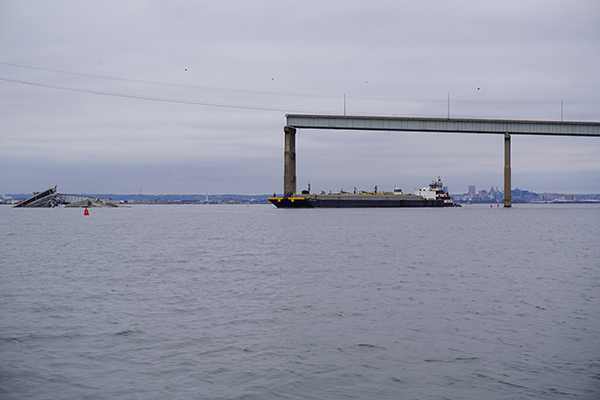
Leveraging Geospatial Data Tools on the Key Bridge Response
In carrying out the joint response after the Key Bridge collapse, the U.S. Coast Guard and other partner agencies leveraged both internal and external geographic information system expertise to provide data-sharing and near real-time monitoring capabilities.