
Article contributed by Deniece Peterson, Guest Contributor, Deltek
As I combed through the data from this year’s Deltek Clarity GovCon Report, one thing kept jumping out at me: the best run project-based businesses don’t guess where they stand. They benchmark. They measure reality honestly, then use that insight to move forward.
That’s the whole premise behind Clarity. Each year, we pull together data and input from hundreds of project-based businesses across government contracting (GovCon). My job, along with the rest of the team working on these reports, is to turn that into something leaders can actually use: data points, benchmarks, and an honest picture of where the market stands, which is not necessarily always a flattering one.
With that in mind, here are three broad themes from this year’s Clarity study that shine light on how leading GovCon firms are adapting to compete, with a breakdown of each trend and what it means for government contractors today.
Intentional Growth Wins
One of the clearest themes from Clarity is that successful government contractors are modernizing their growth strategies. In a market defined by policy changes, shifting priorities, and increased competition, simply chasing every opportunity is no longer a viable strategy. Instead, contractors need to focus on the right customers, the right missions, and the right opportunities.
This year’s Clarity findings show that many contractors maintained or grew revenue despite challenging market conditions. The firms that are finding success increasingly depend on disciplined pipeline management, customer knowledge, and capacity planning. Contractors must evaluate not only whether they can win work, but whether they can profitably deliver it without jeopardizing future opportunities. This means understanding agency priorities, assessing contract mixes, balancing risk, and making thoughtful bid/no-bid decisions.
Strong growth is no longer measured by pipeline volume alone. The organizations that thrive are those that align resources with strategic objectives, focus on mission-driven opportunities, and pursue growth with purpose rather than volume. This means that pursuing every opportunity isn’t necessarily a winning game plan. Sometimes saying “no” can be the best thing for your business development strategy.
Data Drives Better Decisions
Another major theme is the growing importance of data as a competitive advantage throughout the government contracting lifecycle. Agencies are moving faster, acquisition timelines are shrinking, and contractors must make smarter decisions with greater precision.
Data has become the foundation for successful business development, capture, pricing, and customer engagement strategies. Every interaction, forecast, debriefing, proposal, and solicitation contains valuable intelligence that can reveal agency priorities, evaluation patterns, and future procurement trends. When contractors learn to analyze data across multiple opportunities rather than viewing each procurement in isolation, they gain deeper insight into customer challenges and can create more compelling value propositions.
This intelligence-driven approach helps organizations strengthen pipeline quality, better align solutions with mission needs, and ultimately win more business. Competitive advantage increasingly belongs to organizations that can transform information into action, using data to build stronger relationships, refine strategies, and make more confident business decisions.
Governance Must Match AI
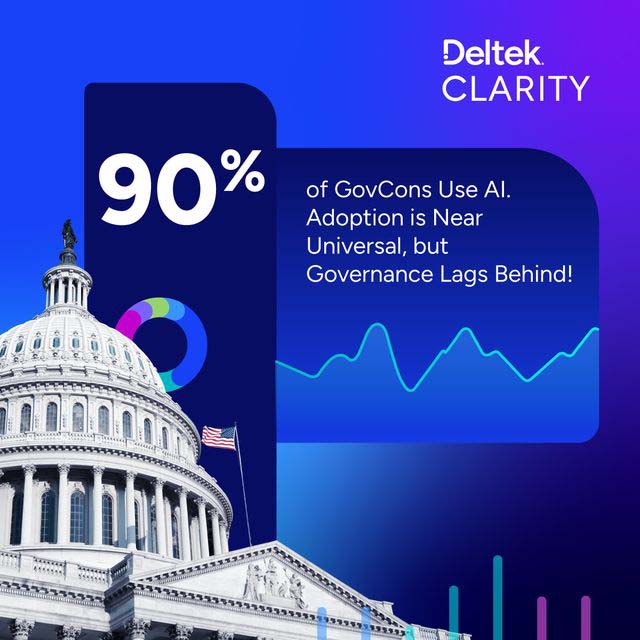
There’s another critical challenge facing the GovCon community: AI adoption is accelerating faster than governance. According to findings in the Clarity Report, AI usage is widespread across government contracting functions, yet many organizations remain in the early stages of establishing governance frameworks and measuring business outcomes. In fact, more than 90 percent of contractors that we surveyed are using AI in some capacity, but only 5 percent reported fully developed AI maturity.
Clearly, while contractors recognize AI’s value for improving productivity and decision-making, many are still determining how to manage risk, protect data, and ensure accountability. Successful AI implementation requires much more than deploying new tools. Contractors need clear policies around who can use AI, what data can be used to train it, what data can be shared, how outputs are reviewed, and how results are measured. And of course, human oversight remains essential to mitigate hallucinations, validate information, and maintain compliance.
Ultimately AI governance is both a risk-management necessity and a business opportunity. Organizations that establish thoughtful guardrails, invest in training, and connect AI initiatives to measurable outcomes will be better positioned to improve efficiency while maintaining trust, security, and compliance in an increasingly digital contracting environment.
Related News
-

Guest Post: How Proposal AI Can Solve Government Contracting Problems
DelTek outlines how AI is becoming a must-have for GovCon proposal teams by streamlining the proposal writing and development process. These tools are built to understand the structure, language, and compliance requirements of federal RFPs, helping teams respond faster and more accurately. -
Guest Post: Top Findings from Deltek’s 2025 GovCon Clarity Study
Deltek’s GovCon Clarity Study identifies three top reasons government contractors expect to either increase or decrease government sales in 2025. -
Guest Post: Six Trends for Federal and SLED Contractors to Watch in 2025
This Guest Post from Deltek, Six Trends for Federal and SLED Contractors to Watch in 2025, considers a complex and shifting landscape in 2025.



Stay up to date on all SAME news and more; download SAME Mobile today!