Viewpoints: Business Development
By Kevin Plexico, M.SAME, and Megan Miller
A pair of recent reports detailing top-of-mind concerns for government contracting and architecture-engineering firms highlight areas of shared interest in the federal sector.
Every year, Deltek analyzes survey responses from hundreds of organizations in the government contracting and A/E fields to produce the Deltek Clarity Government Contracting Industry Study and the Deltek Clarity Architecture & Engineering Industry Study. These comprehensive studies help industry leaders identify challenges that peer organizations are facing and the steps they are taking to overcome them.
Based on the feedback, it is no secret that government contractors and A/E firms are facing a rapidly evolving market environment.
Top-of-Mind Challenges
This year’s surveys highlighted three top-of-mind topics: business development, project management, and artificial intelligence (AI).
Resource Challenges. Survey respondents report a somewhat varied outlook in terms of business development. Despite inflation concerns, A/E firms remain positive with a 10.9 percent net revenue growth forecast, marking an increase over last year (+0.7 points), with small firms reporting an 8 percent net revenue growth forecast. However, these gains come against a backdrop of shifting challenges. While employee turnover has stabilized, it hovers around 14 percent for all firms and 16 percent for small companies. Just like in the government contracting sector, A/E firms in the commercial sector face challenges related to rising labor costs and developing talent to meet project delivery needs. As a response, firms are increasingly seeking suitable teaming partners and leveraging strategic networking to source and close new business opportunities.
Survey responses indicate that firms regularly face a lack of business development resources and tools, which impacts responding to bids and requests-for-proposal. Survey results also highlighted challenges such as increased competition and finding time to nurture client relationships.
Project Delivery Trends. While many A/E firms remain optimistic this year, they have some hesitation given macroeconomic pressures. According to the A/E Clarity Study, 31 percent of projects were delivered over budget, with small firms reporting 34 percent over budget. Survey results appear to indicate that larger companies struggle more with staying on budget and schedule, likely due to more complex projects.
Another challenge is outdated processes. Many firms still utilize spreadsheets and manual data entry for accounting, finance, and resource management. Often, project managers are overburdened and wear multiple hats, having financial and resource management responsibilities in addition to project management functions.
Adopting New Technologies. The top technologies prioritized for investment are, unsurprisingly, machine learning and AI. More than one-third of contracting firms ranked AI and machine learning in their top three priorities. This is fueled in part by developments in AI, where companies have less existing capability built out versus more mature technologies. It is worth noting that 62 percent of A/E firms expect AI to improve operational efficiencies across their enterprise (meaning 38 percent may be less bullish now).
While experts agree that even the best AI tools require human input, firms may find that without investing in tools that leverage cutting-edge technologies, they run the risk of falling behind.
Forecasting Priorities
Overall, the last year has been strong for government contractors and A/E firms, but headwinds are creating certain difficulties.
Larger companies especially are struggling with core project management issues like keeping larger, more complicated work on time and on budget. This has been a priority area for federal agencies as well, which should continue in the new fiscal year.
Detailing Contractor Concerns
In the Deltek GovCon Clarity Study, respondents reported the same top three challenges as last year. At 28 percent, accurate cost forecasting ranked first, followed by poorly defined scope ranking second, and collaboration and communication taking the third spot. Given the increasing cost pressures from inflation, competition, and growing contract and compliance complexity, cost forecasting concerns have risen to the top. Poorly defined scope also may significantly contribute to accurately forecasting costs, making clear lines of sight to project completion difficult. Collaboration and communication issues are a continuing trend from previous years.
In response, nearly half (48 percent) of government contractors are investing in project management training, while 43 percent are developing best practices. These initiatives indicate more internal efforts underway to improve the efficiency of existing staff and processes to combat reoccurring top challenges.
Kevin Plexico, M.SAME, is Senior Vice President, Information Solutions, and Megan Miller is Director, Product Marketing, Deltek. They can be reached at kevinplexico@deltek.com; and meganmiller@deltek.com.
Article published in The Military Engineer, November-December 2024
More from TME
-

ENGINEERS IN CRISIS: The 9/11 Pentagon Response
When a hijacked Flight 77 crashed into the Pentagon on the morning of Sept. 11, 2001, a specially trained military engineering unit based at Fort Belvoir was among the first groups to respond—and its adaptive readiness and selfless service epitomize the legacy of all who swear to “honor and defend the Constitution of the United States against all enemies foreign and domestic.” -
Engineering Diplomacy in Palau
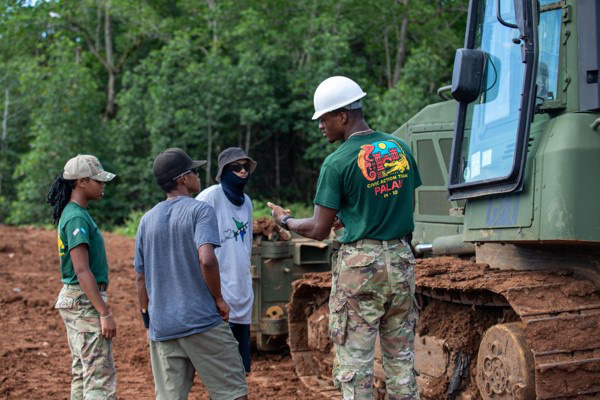
As part of a recent deployment to the Republic of Palau, the U.S. Army’s Civic Action Team 84-10 completed a series of community-focused engineering projects that not only delivered critical infrastructure support but strengthened trust and host-nation relationships in an important strategic area of the globe. -
Scaling AI to Support Wildfire Debris Recovery
To support debris removal operations following the 2025 Los Angeles wildfires, an AI-assisted approach initially used as part of wildfire recovery efforts in Maui was scaled up for parcel-level vehicle detection across a larger, more complex debris removal environment.